· 11 min read
Hotel Direct Booking Strategy: A Plan for Independents
A plain-English hotel direct booking strategy for independent hotels: cut OTA commissions, fix your website and listings, win group stays, and show up in AI search.
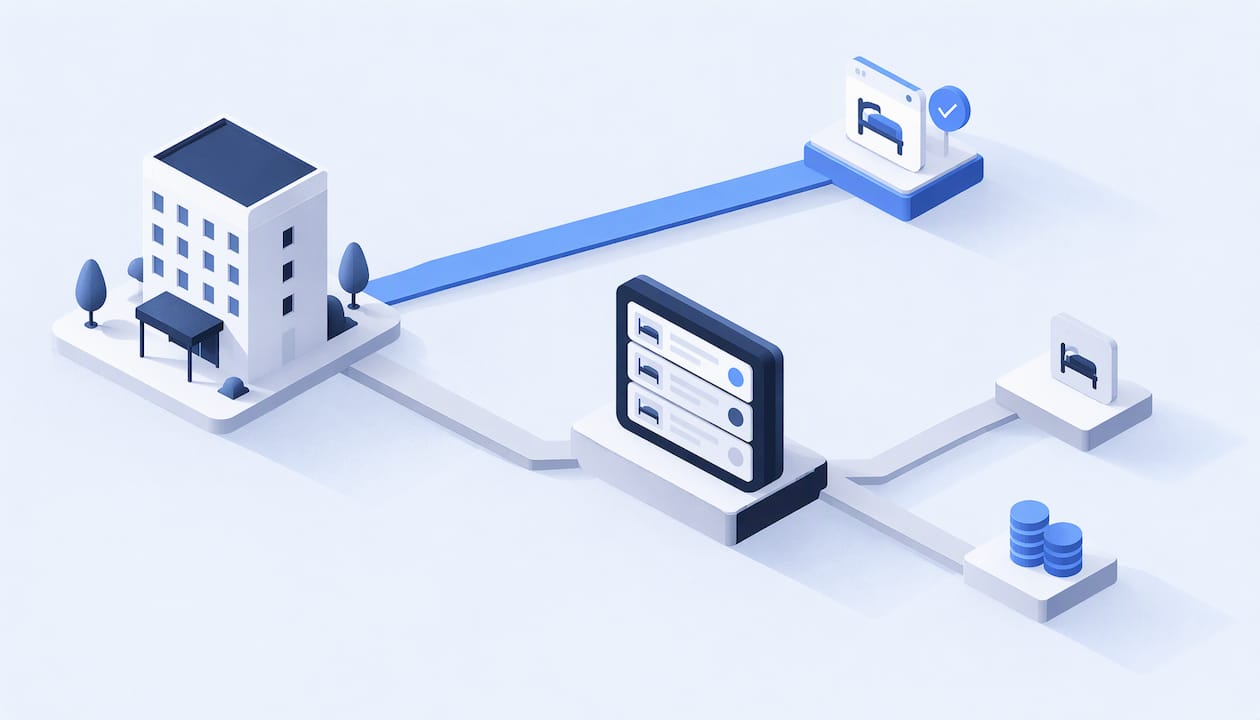
A good hotel direct booking strategy does three things. It makes your hotel easy to find, easy to trust, and easy to book on your own website. Then it keeps guests coming back so you stop paying a commission on every stay. Big chains have whole teams for this. An independent hotel needs a smaller plan that one person can run, or a partner who runs it for you. That is what we build at HotelHero, and this guide shows the plan step by step.
Free with every demo
Get a website guests and AI both recommend.
- See your new AI-visible website on the call
- Social content made and posted for you
- The website is yours to keep, free
Key Takeaways
- Online travel agencies (OTAs) can charge 15% to 30% per booking. Every guest you move to your own site keeps that money in your hotel.
- Direct bookings come from five fixes: a fast site, a short checkout, a clean Google profile, steady social content, and a plan for group sales.
- Most independents do not lack data. They lack the time and skill to use it, so a simple weekly routine beats a big tool.
- AI search is a new door. Guests now ask chatbots where to stay, so your facts must be clear and the same everywhere.
- You do not have to do it alone. Our Direct Booking System is built for hotels without a big marketing team.
Why Direct Bookings Matter Now
An OTA is a site like a big travel marketplace where guests book rooms from many hotels. It brings you guests, but it takes a cut. NetSuite reports commissions of 15% to 30% per booking. It also says direct bookings let you keep that margin, set your own prices and room counts, and collect guest contact details for later marketing.
Here is a simple example. Say a room night sells for $200. At a 15% commission, you pay $30. At 25%, you pay $50. If 20 of your room nights each month moved from an OTA to your own site, you would keep between $600 and $1,000 more. That is before you count repeat stays from guests whose email you now own.
The goal is not to drop OTAs overnight. The goal is to shift the mix, one guest at a time, toward the channel that costs you the least.
Where your bookings come from today
The 2025 State of Distribution report from Phocuswright surveyed more than 21,000 properties. Direct online bookings and OTA bookings each made up 21% of total bookings. GDS (the system travel agents use) was 20%, walk-ins and groups 19%, and phone 18%.

Two lessons come out of that. First, no single channel runs the show, so you can grow your own share. Second, groups, phone calls and walk-ins together are a big slice. A strategy that only fixes your website leaves that slice on the table.
Step 1: Count What You Have
Before you change anything, write down your numbers for the last 12 months. You need five of them:
- Total room nights sold
- Room nights from your website, phone and email
- Room nights from each OTA
- The commission you paid each OTA
- Your average room rate by channel
This takes an afternoon. It gives you a starting line, and it shows you the real cost of each channel in dollars.
The same Phocuswright report found that four out of five independent hotels say they cannot follow shifts in demand. It also found that 53% of independents point to a lack of skill to analyze data as a main problem. So keep your tracking simple. One sheet, updated every Monday, is enough.
A good first goal is a number you can say out loud, such as “move 10% of our OTA nights to direct in six months.” Small goals get done.
Step 2: Build a Website That Closes the Sale
Your site is your front desk online. If it is slow or confusing, the guest goes back to the OTA, and you pay for a guest you already had.
What works:
- Fast on a phone. Most travelers look on mobile. Test your pages on your own phone, on cell data, not office Wi-Fi.
- Real-time rates and rooms. Guests should see what is open and what it costs without sending an email.
- Booking on your own domain. Hospitality Net’s booking engine guide suggests an embedded booking flow that keeps guests on your site, which also helps search ranking.
- A short last page. The same guide says to ask only for name, email and payment details at the end.
- Clear photos and a clear reason to book direct. Say what the guest gets: a better rate, free parking, a late checkout, a welcome drink.
If you want to see how fewer steps help, look at how other industries handle it. This walkthrough on booking online step by step shows how clear pricing and a short path make people more willing to finish a purchase. The same idea applies to a room booking.
Big brands are working on this too. On Nov. 16, 2026, Sonesta launched a redesigned site with faster speed, fewer booking steps, real-time availability and an AI plug-in for search and booking. You do not need a chain budget to copy the basics: speed, fewer steps, and live rates.
We cover this topic in more depth in our guide to a direct booking website. Our Direct Booking System is built for independent hotels, and our promise is a 30-day deployment.
Step 3: Fix Your Online Presence
Many guests never reach your website first. They see your Google Business Profile, your OTA pages and your reviews. If those are messy, they leave or book through the OTA.
A quick audit:
- Google Business Profile. Check your name, address, phone, hours, photos, and a link to your booking page. Keep it the same as your website.
- OTA listings. Make sure your descriptions, photos and amenities match across every site. Wrong details cause bad reviews and lost trust.
- Reviews. Reply to every review, good or bad, in a calm and kind voice. Ask happy guests to leave one at checkout.
- Rate parity. Your site should never be more expensive than an OTA for the same room. If it is, guests have no reason to book direct. Our hotel channel management guide explains how to keep rates in line.
This is the work our Online Presence Repair service covers, including Google Business Profile optimization, OTA listings management and reputation review services. You can read more on our online presence repair page.
Step 4: Get Found in Search, Maps and AI Answers
Guests find hotels in three main ways now: search engines, maps, and AI assistants. Each one rewards the same thing: clear, correct and consistent facts about your hotel.
Search and maps
Create a page for each room type and each thing guests love about your location. Name the neighborhood, the nearby events, the hospital, the stadium, the campus. A traveler who types “hotel near the convention center” should land on a page that says exactly that.
Metasearch
Metasearch sites show prices from many sellers on one page. Google’s hotel results are one example. When your rates appear there and link to your own booking engine, guests can book with you without paying an OTA. Ask your booking engine provider how to connect your rates to Google’s hotel listings. A verified Google Business Profile is the place to start.
AI search
More travelers now ask chatbots questions like “Where should I stay near the lake with a dog?” The assistants pull from websites, reviews and listings. If your facts are thin, old or different on each site, you may not be named at all.
This is called Generative Engine Optimization (GEO), or AI Engine Optimization (AEO). In plain words, it means writing your site so AI tools can read it, understand it and quote it. The basics:
- Write plain answers to real guest questions: Is parking free? Are pets allowed? How far is the airport?
- Use the same name, address, amenities and policies on every site.
- Keep fresh content tied to local events.
- Collect real guest reviews that mention what makes your stay special.
Our GEO and AEO service is built to make a hotel’s website visible to AI tools.
Step 5: Build an Audience with Social Content
Offers, loyalty perks and email only work if guests know you exist. Social media is where an independent hotel can build that audience without paying for every click.
Keep it simple:
- Post a few times a week. Show rooms, staff, food, and the town.
- Tie posts to local events: festivals, game days, concerts, conferences. Travelers plan around these dates.
- Share guest photos and stories, with their permission. Real guests are more believable than a brochure.
- Point every post to one place: your booking page.
The hard part is staying steady. Most owners start strong and fade in a month. We handle this through curated social posts and user generated content (UGC), which means content that real guests create. See our content marketing services and social media management pages.
Step 6: Give Guests a Reason to Book Direct and Return
A direct guest should get something an OTA guest does not. Ideas that cost little:
- A free breakfast, drink or parking spot for booking on your site
- A late checkout when available
- A small discount on the next stay
- A simple loyalty program, even a card or an email list that gets first access to deals
Phocuswright’s reporting credits direct booking gains to brand site upgrades, metasearch links and loyalty. All three are within reach of a small hotel.
Once a guest books direct, you have their email. Send a thank-you, a pre-arrival note with local tips, and a follow-up after the stay. Then send a seasonal offer. This is how a first stay turns into the next one without paying anyone a fee.
Step 7: Win Group Bookings Directly
Groups are easy to forget. They fill many rooms at once, and they often book by phone or email. In the Phocuswright data, walk-ins and groups made up 19% of total bookings.
Who books groups: sports teams, wedding parties, family reunions, corporate trainers, and work crews. Each one has a person who decides. A short, friendly message to that person, with a clear rate and a fast reply, often wins the stay.
Here is a basic routine:
- Make a list of local groups and companies that send people to your area.
- Write one short email with your rate, your room count and a simple way to book.
- Follow up twice. Most deals are won on the follow-up.
- Track each lead in a sheet.
The trouble is time. Front desk staff are busy. Outreach gets dropped. We run proactive sales outreach for group bookings, and we are adding Construction Crew Prospecting, which targets crews that need rooms for weeks at a time. Learn more on our crew prospecting page.
Step 8: Balance OTAs and Direct, Do Not Fight Them
OTAs still help you reach new guests. The aim is to use them for discovery and win the repeat business yourself. Think of three jobs:
- OTA: introduce your hotel to people who do not know you.
- Your website: close the sale and hold the guest relationship.
- Email and social: bring guests back.
To see how booking channels compare for who keeps the guest, this article on direct booking versus third-party platforms lays out the idea well. It is written about restaurants, but hotels face the same question of who owns the customer.
If you want more ideas for the mix, read our independent hotel marketing playbook and our guide on how to increase hotel bookings.
A Simple 90-Day Plan
| Weeks | Focus | Result to look for |
|---|---|---|
| 1 to 2 | Count channels and commissions | A baseline sheet |
| 3 to 4 | Fix Google profile and OTA details | Matching facts everywhere |
| 5 to 8 | Speed up site, shorten checkout, add a direct perk | More site visitors finishing a booking |
| 9 to 12 | Start social posts, group outreach and AI-ready pages | New leads and more mentions |
Check the sheet every Monday. If the direct share goes up and commissions go down, the plan works.
Where HotelHero Fits
Most independent owners know what to do. The hard part is doing it every week while running a hotel. Our Direct Booking System puts the pieces in one place: a remote sales team for group bookings, social media management to build a guest audience and direct booking funnels, and online presence repair. We designed it to cut OTA dependency and grow commission-free stays. If you want to see what that looks like for your property, start at hotelhero.ai.
Our Point of View
Independent hotels do not lose direct bookings because owners lack ideas. They lose them because the work never stops. The site needs care, the profile needs care, the posts need care, and the group leads need a reply today.
That is why we put hospitality know-how, sales outreach and marketing under one roof. A website alone does not fill rooms. A website that AI tools can read, backed by steady local content and a person who calls the group planner, can.
We believe an independent hotel should be able to compete with big brands without a big team. That is the idea behind everything we build.
Chirag
FAQ
What is a direct booking for a hotel?
A direct booking is a reservation a guest makes with your hotel itself, through your website, phone or email. No middleman is involved. That means you avoid OTA commissions, which can run 15% to 30% per booking, and you get the guest’s contact details.
How can a small hotel get more direct bookings?
Start with a fast mobile site and a short checkout. Then match your Google profile and OTA listings, add a perk for booking direct, and post local content on social media. Add outreach to groups and crews for extra volume.
Should my hotel stop using OTAs?
Not at first. Use OTAs to be discovered, and aim to win repeat stays directly with email, offers and a strong website. Track your channel mix so you can shift it step by step.
How does AI search change direct booking?
Travelers now ask chatbots where to stay. Those tools favor clear, consistent facts and helpful answers on your site. Writing for AI visibility, often called GEO or AEO, helps your hotel get named in those answers.
Sources
- NetSuite: How to Increase Direct Hotel Bookings
- PhocusWire: Hotels prioritize direct bookings but lack data clarity
- Hospitality Net: 11 Ways to Optimize Your Hotel Booking Engine
- Asian Hospitality: Sonesta Redesigns Website to Drive Direct Hotel Bookings