· 11 min read
Direct Booking Website: How Hotels Get More Direct Stays
Learn what a direct booking website is, what it needs to turn visitors into guests, and how independent hotels can cut OTA fees. Simple steps, no jargon.
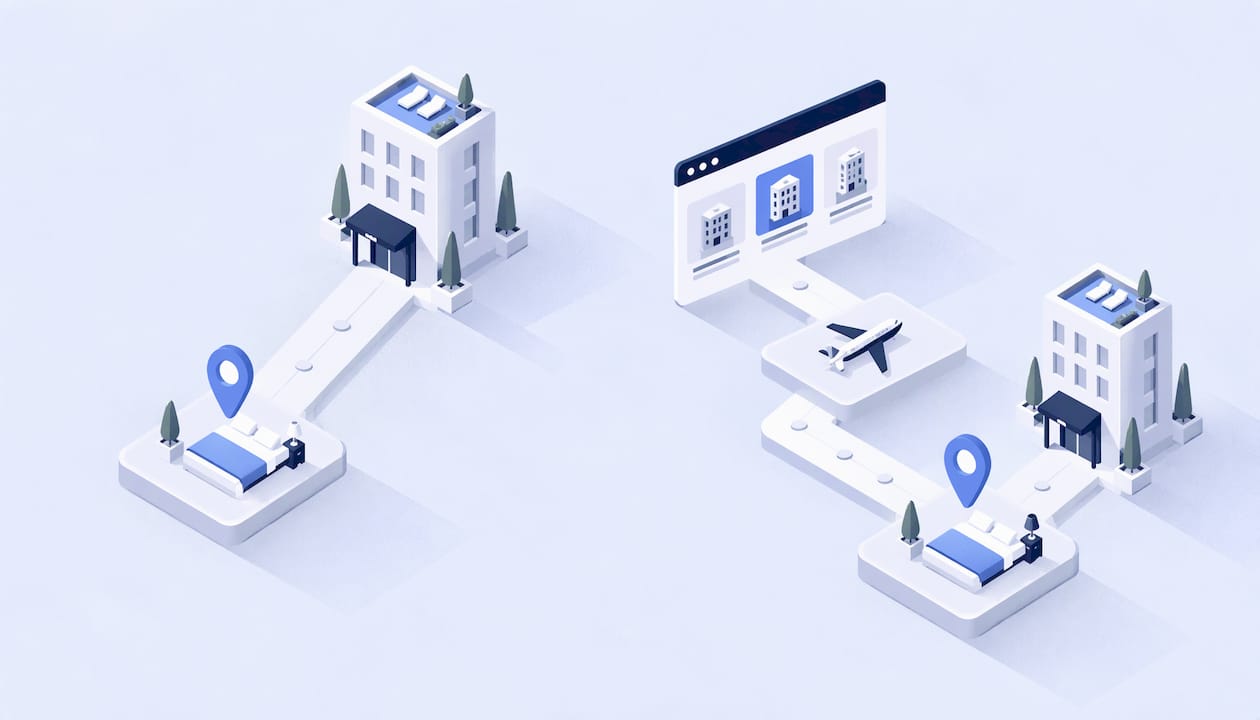
A direct booking website is your hotel’s own site where a guest can pick dates, choose a room, and pay without leaving. No middleman sits in the way. The guest books with you, you keep the money, and you keep the guest’s contact details.
This guide shows what a good one needs. It also shows how to make it fast, how to get found in Google and in AI answers, and how to judge a website service. We wrote it in plain words so you can use it today.
Free with every demo
Get a website guests and AI both recommend.
- See your new AI-visible website on the call
- Social content made and posted for you
- The website is yours to keep, free
Key Takeaways
- A direct booking website lets guests book and pay on your own domain, so you skip OTA commissions.
- Speed, trust, a clear reason to book direct, and a short booking path matter most.
- Short and clean facts help AI tools and Google understand your hotel.
- Fix the basics first: contact details, rates, photos, Google Business Profile, and listings that match.
- Judge any website service by what it does for direct bookings, not by how the site looks.
What a direct booking website is
Think of two doors into your hotel. One door is an online travel agency, or OTA. Sites like Booking.com and Expedia are OTAs. The other door is your own website.
When a guest uses the OTA door, the OTA owns the first part of the story. It shows your rooms next to many others. It also takes a fee for each stay. One industry guide says OTAs commonly charge 15% to 25% in commission on every reservation.
When a guest uses your door, the story is yours. A direct booking website has three main parts:
- Your pages. Photos, room details, the address, the story of your place, and things to do nearby.
- A booking engine. This is the tool that shows rooms and rates, checks dates, and takes payment. It should sit on your own domain, so the guest never feels like they left.
- Proof and perks. Reviews, secure payment signs, and a reason to book with you.
The booking engine is the heart. A site with pretty pictures and a “call us” button is a brochure. A site that lets a guest finish a booking in a minute is a direct booking website.
Why it matters for independent hotels
A big chain has a huge brand and a big team. An independent hotel has neither. The OTAs fill that gap, but they charge for it.
A simple example shows the cost. Say your hotel takes $15,000 a month from OTA bookings. At an 18% fee, you pay $2,700 a month. That is $32,400 a year. Each stay you move to your own site keeps part of that money in your pocket. (This math uses one example fee. Your own contracts may differ.)
There is a second gain. When a guest books direct, you get their email and their habits. You can invite them back. You can tell them about a local event. An OTA keeps that link for itself.
Five traits of a strong direct booking website
One industry guide sums up the best hotel sites in five traits: fast, clear, trustworthy, direct-incentivised, and frictionless. Here is what each one means in real life.
Fast
Most guests look on a phone. If the page is slow, they leave. The same guide says pages should load in under 3 seconds on mobile. Here is how to get closer to that:
- Shrink big photos before you upload them.
- Remove add-ons and pop-ups you do not need.
- Use one good hosting plan, not the cheapest one.
- Test your site on a real phone, on regular mobile data, not just office Wi-Fi.
Clear
A guest should know in five seconds what kind of place you are. Is it a quiet inn near a lake? A pet-friendly stop for road trips? A place for crews who work in town all week? Say it at the top of the home page, in one short line, next to a strong photo.
Trustworthy
Guests will not type a card number into a site that feels shaky. Put proof near the top and near the buy button. Good proof includes:
- Real guest reviews with names or first names.
- Secure payment icons.
- Your phone number and street address, easy to see.
- Clear cancel rules, written in plain words.
This matters a lot. A trade article on turning browsers into bookers says more than 70% of travelers put security ahead of price. Place security badges and reviews near the spots where guests decide.
Direct-incentivised
Give guests a reason to skip the OTA. The same trade article lists perks that work: a discount, flexible cancel rules, a room upgrade, or early check-in. Pick perks that cost you little but feel good to a guest. A free late check-out or a welcome drink often costs far less than a 15% fee.
Put the perk where people see it, such as a small banner on the booking page. Say it simply: “Book here for free parking and early check-in.”
Frictionless
The path to a booking should be short. The best flow is simple: dates, room, guest details, payment. The PriceLabs guide says that if a guest needs more than four screens to confirm, you lose bookings. Each extra box or page is a place to quit.
Build the booking path step by step
Here is a checklist you can hand to whoever builds or fixes your site.
- Put a “Book now” button on every page. Keep it in the top bar. On a phone, keep it where a thumb can reach it.
- Show rates and open dates fast. The trade article says guests should not need many clicks to see price and availability. Do not hide rates behind a form.
- Use clear action words. “Check dates” and “Book your room” beat “Submit.”
- Ask only for what you need. Name, email, phone, and payment. Skip long forms. Let the phone autofill what it can.
- Show the total price early. Surprise fees at the last step make guests quit and feel tricked.
- Send a clear confirmation. Email it right away. Add check-in time, address, and parking tips.
- Test it every month. Book a room yourself, on a phone and a laptop. If you get stuck, so will a guest.
Make your site easy for Google and AI to read
More and more guests ask an AI tool, “Where should I stay in a small town near the national park?” The tool gives a short list. You want your hotel on it.
One study looked at 450 hotel questions. It found which site traits went with showing up in AI answers. The biggest ones were Schema.org markup for hotels, with a 6.2x lift, plus a direct booking engine on your own domain (3.3x), a review score above 4.5 (2.8x), FAQ content (2.1x), and passing Core Web Vitals (1.9x). This study came from hotels in Europe, so treat it as a guide and not a promise for your town. Still, the pattern is easy to follow.
Here is what that means in simple words:
- Schema markup is hidden code that tells machines, “This is a hotel. Here is its name, address, and rating.” Ask your web builder to add it.
- A booking engine on your domain shows that guests can book with you right there.
- Good reviews, visible in the code, back up your claims.
- FAQ content answers real questions, like “Is parking free?” or “Do you take pets?”
- Core Web Vitals are Google’s speed and ease checks. You can run them in free tools from Google.
Another guide on AI search adds that core facts should be explicit, current, and easy to read. That means your name, address, phone, room types, amenities, and booking options. It also says clean links and trust signals seemed to matter more than schema alone.
Want to go deeper on this? Read our guide on how independent hotels get recommended by AI.

A first-month fix list
The same AI search guide says most independent hotels should spend the first month on the signals that are easy to check and easy to forget. Use this list:
| Task | What to check |
|---|---|
| Contact details | Same phone, address, and email on every page |
| Room pages | One page per room type, with size, bed, view, and photos |
| Rates | Current prices that match your booking engine |
| Booking button | Easy to see on every page |
| Google Business Profile | Hours, photos, link to your site, fresh posts |
| OTA listings | Same facts and photos as your own site |
| Local listings | Tourism boards and city pages list you the same way |
When your facts match everywhere, machines trust them more. A guest also trusts them more.
Words and pages that help people find you
Many people search things like “hotel website best practices” or “hotel website optimization.” Under all those phrases is one simple goal: help the right guest find a page that makes booking easy.
Write pages for the questions your guests ask. For example:
- A page for each room type.
- A page for your town, with events, food, and trails.
- A page for groups, weddings, or work crews, if you want them.
- A short FAQ on parking, pets, check-in, and cancel rules.
Use the words guests use. A guest types “pet friendly hotel near Asheville,” not “canine-accommodating lodging.” Say it the plain way.
Local events are a gold mine. A fall festival, a college move-in weekend, or a big game all bring guests. A short post on your site and on social media can catch them while they plan. Our guide on hotel social media marketing shows how to do this without a big team.
What a hotel website service includes, and what it costs
You may not want to do all this yourself. That is fair. A good website or optimization service usually covers some mix of these jobs:
- Site design and fixes for speed and phones.
- A booking engine set up on your domain.
- Keyword and page work, so guests can find you.
- Local listing and Google Business Profile cleanup.
- Review work.
- Regular reports.
Prices vary a lot. For a sense of scale, a big hotel brand once published a program for its hotels. Marriott’s 2016 brochure listed an SEO Foundations program at $5,500 a year. It included keyword work for seven pages, photo gallery and content work, local listing cleanup, and monthly reports. That price is from 2016, so today’s prices will differ. Use it only as a picture of what such a package covers.
How to judge a service
Ask these questions before you sign anything:
- What will it do for direct bookings? Look for a plan tied to bookings, not just traffic.
- How long until the site is live? A clear timeline is a good sign.
- What will I see each month? You want plain reports, not a pile of charts.
- Who does the work? Look for people who know hotels.
- What happens if I leave? You should own your domain, content, and guest data.
Our perspective
We built HotelHero for independent hotels that do not have a big marketing team. We see the same story again and again. A hotel has a nice property and good reviews. But the website is slow, the booking path is long, and the best guests come in through OTAs that take a cut.
We think a direct booking website is only the start. A site by itself will not fill rooms. Guests also need to find you. That means a site that AI tools and Google can read, a Google Business Profile that is fresh, and social posts about the things happening in your town.
That is why we put these pieces together. We pair a direct booking system with content, local visibility, and sales outreach for group stays. We aim to deploy in 30 days, because a hotel should not wait half a year to see a better site. Our goal is simple: more commission-free stays for you.
Chirag
Put it all together with HotelHero
If you want a direct booking website without hiring a full team, we can help. Our Direct Booking System is built for independent hotels. We pair it with AI visibility work, so guests who ask AI tools about places to stay can find you. We also help with online presence repair, such as your Google Business Profile and OTA listings. When you are ready to talk, reach out to our team.
For more ideas, see our direct booking playbook for independent hotels and our guide on how hotels get found online.
A simple 30-day plan
You do not need to fix everything at once. Here is one way to start.
Week 1: Look. Book a room on your own site from your phone. Count the screens. Write down every spot where you got stuck. Check that your phone, address, and rates match everywhere.
Week 2: Fix the path. Cut extra form boxes. Show the total price early. Add a clear “Book now” button to every page. Add a direct-booking perk.
Week 3: Add trust. Place reviews and secure payment signs near the buy button. Add a short FAQ. Ask your web builder to add hotel schema.
Week 4: Spread the word. Update your Google Business Profile. Make sure OTA listings match your site. Post about one local event with a link to book direct.
After 30 days, check your numbers. How many guests started a booking? How many finished? Where did they leave? Those answers tell you what to fix next.

FAQ
What is a direct booking website?
It is your hotel’s own website with a booking engine on it. Guests pick dates, choose a room, and pay there. You skip the OTA fee and you keep the guest’s contact details.
How do I get more direct bookings?
Make the site fast, clear, and trusted. Offer a perk for booking direct, and keep the booking path short. Then keep your Google Business Profile and listings fresh so guests can find you.
Does my hotel need schema markup?
Schema markup helps machines read your hotel’s facts. One study of AI hotel answers found it was the strongest sign tied to showing up. It works best with clear pages, matching facts, and good reviews.
How much does hotel website optimization cost?
It depends on the size of the job and who does it. Costs range from a one-time fix to a monthly plan. Ask for a clear list of what you get and how it ties to direct bookings.
Sources
- Do’s and Don’ts of Converting Travel Browsers into Bookers, Hospitality Net
- Hotel Direct Booking Websites: 12 Best Practices for 2026, PriceLabs
- How Does AI Decide Which Hotels to Recommend?, Nokumo
- How Hotels Appear in AI Search Results Before Guests Book, Coir Consulting
- Digital Services Brochure, Marriott (2016)
- Hotel Booking Engine: The Complete Guide for 2026, Asksuite