· 13 min read
Hotel ChatGPT Visibility: How to Get Your Hotel Recommended
Learn how to check if ChatGPT mentions your hotel, fix wrong details, and get recommended by AI so more guests book direct. Simple steps for independent hotels.
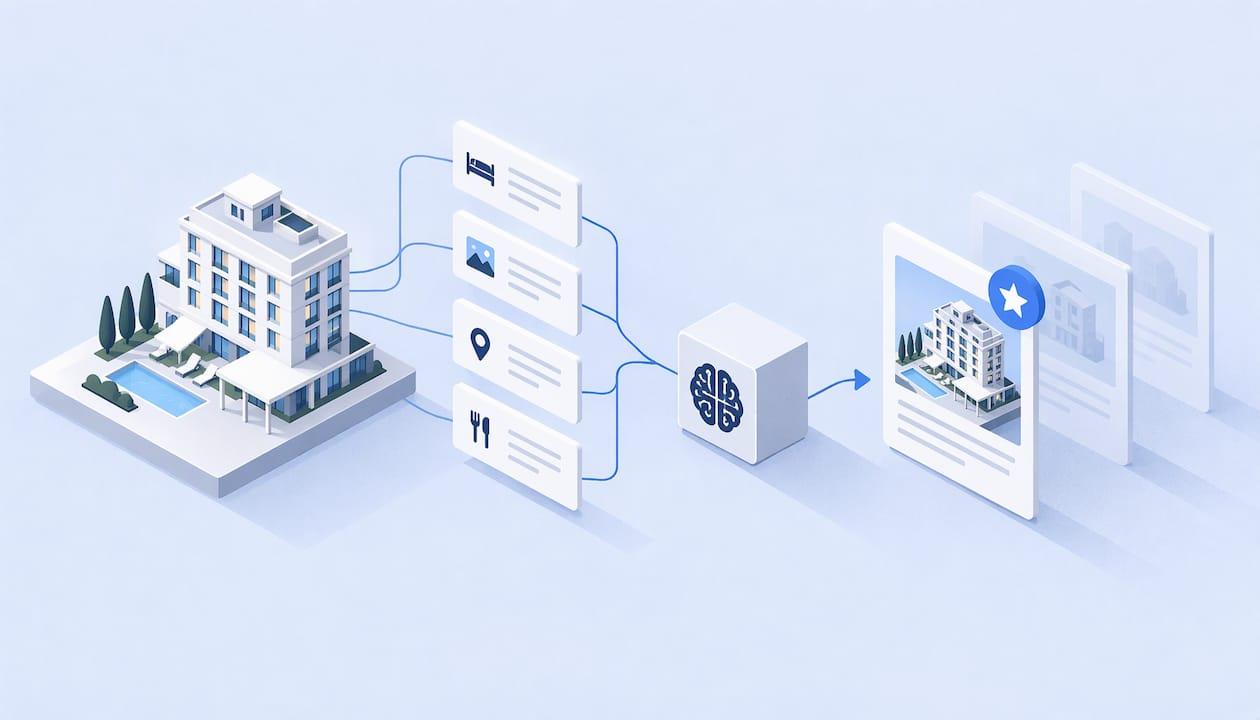
Hotel ChatGPT visibility means that when a traveler asks ChatGPT where to stay in your town, your hotel is in the answer, and the details are right. You get there in three moves: check what ChatGPT says today, fix the facts it reads about you, and keep your website and listings clear and consistent. We build this for independent hotels through our AI-visible website and GEO service, and this guide gives you the full routine so you know what good looks like.
Free with every demo
Get a website guests and AI both recommend.
- See your new AI-visible website on the call
- Social content made and posted for you
- The website is yours to keep, free
Key Takeaways
- ChatGPT answers hotel questions by searching the web, so the pages it can read about your hotel decide what it says.
- Start with an audit: ask ChatGPT about your hotel by name, then ask the questions a traveler would ask, and write down the results.
- Keep your name, address, rooms, amenities and policies the same on your website, Google Business Profile and listings.
- Make sure your site is readable by AI crawlers, with clear text, an FAQ and structured data.
- Repeat the check every week or two, and track visits, inquiries and bookings as separate numbers.
Why ChatGPT visibility matters for independent hotels
More guests now ask an AI tool for a hotel before they open a booking site. The answer is short. It names a few places, and that is it. If your hotel is not one of them, the guest may never see your name.
This hits independent hotels hardest. A big brand has thousands of pages and listings that feed AI tools. You have one website, one Google profile and a few listings. That is also good news. A small, clean set of facts is easy to fix, and one fix can change what the tool says.
The goal is not to chase a trick. The goal is to be the easy, trusted answer. When ChatGPT names your hotel and links to your site, the guest can book with you directly and you skip the OTA commission. For more on this shift, see our guide to how guests find your hotel with AI.
How ChatGPT decides which hotels to show
ChatGPT does not keep a secret list of hotels. For current questions, it can search the web and give links to sources. That means your public pages are the raw material.

Search Engine Land described how ChatGPT handled local searches in a test. By that account, it searched Bing, scanned the first 20 to 30 results, looked closely at 5 to 8 sources, and picked 3 to 5. It favored sources that showed an average star rating and could be checked and linked to, and that were not behind a paywall.
What does that tell a hotel owner?
- You must show up in regular search. If your hotel is hard to find on Bing and Google, it is hard to find for ChatGPT.
- Pages must be open. A page that is blocked or hidden cannot be read or cited.
- Ratings and reviews matter. Star ratings show up in what the tool picks.
- Clear facts win. A page that states rooms, prices and policies in plain words is easy to quote.
OpenAI also tells site owners how to be included. Any public website can appear in ChatGPT search, and you should not block OAI-SearchBot in your robots.txt file. That is the first technical check on your list.
Step 1: Check what ChatGPT says about your hotel now
Before you change anything, get a baseline. This takes about an hour and costs nothing but time.
Run brand questions first
Open ChatGPT and ask about your hotel by name. Use plain questions like these:
- What can you tell me about [your hotel name] in [your city]?
- What room types and amenities does [your hotel name] have?
- Does [your hotel name] have parking, a pool or a pet policy?
- What do guests say about [your hotel name]?
These questions show what the tool already believes about you. They also show made-up details. Many owners are surprised to find a closed restaurant, a wrong star level or an old address.
Then ask like a traveler
Next, ask the questions a guest would ask without knowing your name:
- Best boutique hotel in [your town] for a weekend
- Pet-friendly hotel near [local landmark]
- Where to stay near [hospital, stadium, college, lake or trail]
- Hotel in [your town] for a family with two kids
Try the same questions in a few tools, such as Gemini, Perplexity and Copilot, since each one pulls from different places.
Record what you see
Use a simple sheet with these columns:
| Column | What to write |
|---|---|
| Date | The day you ran the question |
| Tool | ChatGPT, Gemini, Perplexity or Copilot |
| Exact question | Copy the words you typed |
| Did we appear? | Yes or no, and in what position |
| Who else appeared | The hotels named next to you |
| Facts right or wrong | List each error |
| Sources shown | The web pages the tool linked |
Run the audit again on another day and compare. Answers can change from one run to the next, so one test is not enough. The sheet you build is your baseline.
Check the sources it cites
OpenAI says that search results and citations can be incomplete, outdated or wrong. So open each link the tool gives. When a wrong fact came from an old listing or a third-party page, you have just found the page to fix.
Step 2: Fix the facts AI reads about you
Most wrong answers come from messy facts. Fixing them is the fastest win.
Make one source of truth
Write one sheet with your hotel’s core facts:
- Legal and public name
- Address and phone number
- Number and type of rooms
- Amenities, such as Wi-Fi, parking, breakfast, pool, EV charging
- Check-in and check-out times
- Pet, cancellation and child policies
- Photos you want shown
Then make every page match that sheet. Check your website, your Google Business Profile, your OTA listings, and any directory or local tourism page. Small gaps, like “Inn” on one page and “Hotel” on another, can confuse a tool that is trying to decide which property is which.
Your Google Business Profile deserves special care. It often shows up in local results, and it is easy to edit. If it is out of date or thin, fixing it is a good first day of work. Our online presence repair service covers the Google Business Profile, OTA listings and reviews as one job, so the facts line up everywhere.
Do not forget your OTA listings
OTA pages are a source that AI tools can read. If a listing says you have a pool and you do not, a tool may repeat it. Check the text, photos and amenity lists on each OTA page, and fix what is wrong. This does not mean you want guests to book there. It means you want the facts correct wherever the tool looks.
Reviews shape the answer
Since star ratings show up in what ChatGPT picks, reviews matter. Reply to reviews in a calm, helpful tone. Mention real details, like breakfast, parking or a quiet room, when you answer. Ask happy guests to leave a review while the stay is fresh. For a full routine, read our simple guide to hotel online reputation management.
Step 3: Make your website easy for AI to read
Your website is the one source you fully control. Make it clear to people and to crawlers.
Let the crawlers in
Check your robots.txt file. If it blocks OAI-SearchBot, ChatGPT search may not use your content in its summaries. OpenAI says that a crawler also needs access to a page before it can read that page’s meta tags, so allow the bot and keep your pages open. Ask whoever built your site to check this today. It is a ten-minute job.
Put key facts in plain text
Some sites load their content with scripts, which can leave a page looking empty to a simple crawler. Keep the important facts, such as rooms, rates, amenities and policies, as plain text on the page. Do not hide them in images, PDFs or pop-ups. If a guest can read it on the page without clicking, a crawler probably can too.
Add structured data
Structured data is a small block of code that labels facts on a page. It tells a machine, “this is the hotel name, this is the address, this is the check-in time.” Google publishes a lodging data format that lists the kinds of facts a property can describe, such as services, policies, food and drink, pools and wellness. Use that list as a prompt for what to state clearly on your site: rooms, amenities, parking, payment types, and more.

For most hotels, this is a good job for a web team to do once and keep current.
Write an FAQ in guest language
Guests type full questions. So write your FAQ the same way:
- Is there free parking at the hotel?
- Are dogs allowed, and is there a fee?
- How far is the hotel from [landmark]?
- What time is check-in?
- Do you have rooms for four people?
Give each answer in two or three clear sentences that make sense on their own. A tool can lift that answer straight into its reply. Put the real numbers in, such as minutes of drive time and fees in dollars.
Build pages around your place
A page that could describe any hotel will not stand out. Write about your town. Name the events, the trails, the hospitals, the colleges and the businesses near you. Say who stays with you and why. This helps with the traveler-style questions like “where to stay near the stadium.” Our guide on hotel LLM optimization goes deeper on how independent hotels get recommended by AI tools.
Step 4: Build your presence beyond your own site
Your site is not the only place an AI tool looks. It can pull from listings, reviews, local pages and travel articles too. So spread clear facts, and good words about you, across the web.
Things that help:
- Local tourism pages. Ask your visitors bureau or chamber of commerce to list you, with the right details.
- Local articles and event pages. When you host or sponsor something, make sure the page names your hotel and your town.
- Social posts. Regular posts about local events and real guest moments keep your name active. Read our guide to hotel social media marketing for ideas.
- Real guest content. Photos and stories from guests show your hotel the way travelers see it.
The point is a steady trail of accurate, friendly mentions. A single post will not move much. A habit will. For the wider picture, our piece on hotel online brand visibility shows how these parts fit together.
Step 5: Track results and measure bookings
AI answers change. So tracking is a routine, not a one-time task.
Repeat the audit on a schedule
Run the same questions every week or two. Write down the date, the exact words and the tool. Save the answers and the links they cite. Keep a change log too: when you updated a page, fixed a listing or added an FAQ. That way you can see which work was followed by a change.
Be careful with cause and effect. If your hotel starts to appear after an update, that is a good sign, but it is not proof the update did it. Treat it as a clue.
Track four numbers separately
| Measure | What it tells you |
|---|---|
| Mentions | How often the tool names your hotel in your test questions |
| Citations | How often it links to your website |
| Visits | Traffic that arrives from ChatGPT |
| Inquiries and bookings | Real business that follows |
OpenAI notes that publishers who allow OAI-SearchBot can see referral traffic in analytics tools, and that ChatGPT adds the tag utm_source=chatgpt.com to links, as its publisher FAQ explains. In your analytics, look for that source. Then follow those visitors into your booking engine to see who books.
Do not expect a straight line from a mention to a booking. Many guests see your name in an answer, then search for you later by name or visit your site another day. Watch for growth in direct searches, calls and direct bookings over time, along with the ChatGPT visits you can see.
A simple 30-day plan
Here is a plan an owner or a manager can follow without a big team.
- Week 1: Audit. Run brand and traveler questions in four tools. Fill in your sheet. List every wrong fact and the page it came from.
- Week 2: Fix the facts. Write your fact sheet. Update your Google Business Profile, OTA listings and directory pages to match it.
- Week 3: Fix the site. Check robots.txt, put key facts in plain text, add structured data and publish an FAQ in guest language.
- Week 4: Add local content and recheck. Publish one page or post about a local event or place near you. Run your audit again and compare.
Then keep going. Run the audit every week or two, answer new reviews and add a fresh local post each month.
Common mistakes to avoid
- Blocking crawlers by accident. A setting meant to stop spam bots can also shut out the bot ChatGPT search uses.
- Different facts in different places. Old room counts, old phone numbers and old policies cause wrong answers.
- A thin website. One page with a photo and a booking button gives a tool little to quote.
- Testing once. One answer is a snapshot. Test more than once, on more than one day.
- Judging by bookings alone, too soon. Track mentions and visits as well as bookings, because each shows a different part of the path.
What we do at HotelHero
If you do not have a marketing team, this routine can feel like a lot. That is why we built our service for independent hotels. We build AI-visible websites and handle GEO and AEO, and our online presence repair covers your Google Business Profile, OTA listings and review work. We pair that with social content that speaks to local events and travelers. Our direct booking system is built to cut OTA reliance and grow commission-free bookings, and we guarantee deployment in 30 days. You can reach us through our contact page.
Our view on ChatGPT visibility
Owners often ask us which trick will get their hotel into ChatGPT. We tell them there is no trick. There is a job, and it is the same job good hotel marketing has always been: say clearly who you are, say it the same way everywhere, and keep saying it.
What has changed is the reader. A guest used to scroll through ten blue links. Now one answer may be all they see. That makes clear, correct facts worth more than ever, and it favors the independent hotel that knows its town. A big chain cannot write about your local festival, your regulars or the road crews who stay with you every week. You can.
That is why we pair an AI-visible website with steady content and a fixed-up online presence. The website gives the tools something clean to read. The content and listings give them more places to find the same story. And the direct booking system gives the guest an easy way to book with you instead of paying a commission.
Our advice is to start small and start now. Audit, fix the facts, and track. Every step you take makes your hotel easier to name.
Chirag
FAQ
How do I know if ChatGPT recommends my hotel?
Ask it. Start with your hotel’s name and city, then ask traveler-style questions like “best hotel near [landmark].” Record whether you appear, where, and which facts are right. Repeat on another day, because answers can change.
Can I pay to be listed in ChatGPT hotel answers?
The path described here is organic. ChatGPT can search the web and cite pages, so clear, open and consistent pages give it more to use. Focus on your site, your listings and your reviews. We cover this work in our AI visibility service.
Why does ChatGPT show wrong details about my hotel?
It reads pages from across the web, and some may be old or wrong. OpenAI says citations can be incomplete, outdated or incorrect. Open the sources it cites, find the page with the error and correct it at the source.
How long does it take to show up?
It depends on how often the pages are read again and how clear your facts are. Some fixes, like a corrected listing, can show sooner than others. Keep a change log and re-run your questions every week or two to see movement.
Does ChatGPT visibility lead to direct bookings?
It can, because a mention with a link to your site sends the guest to you rather than an OTA. Track mentions, citations, visits, inquiries and bookings as separate numbers. Follow ChatGPT visits through your booking engine to see which ones book.
Sources
- Searching the web with ChatGPT, OpenAI Help Center
- How does ChatGPT conduct local searches?, Search Engine Land
- Google Lodging Format Schema, Google for Developers