· 11 min read
Hotel Reservation Call Center: How to Turn Calls Into Bookings
Learn what a hotel reservation call center does, how to handle booking calls, and which numbers to track so more callers book direct with your hotel.
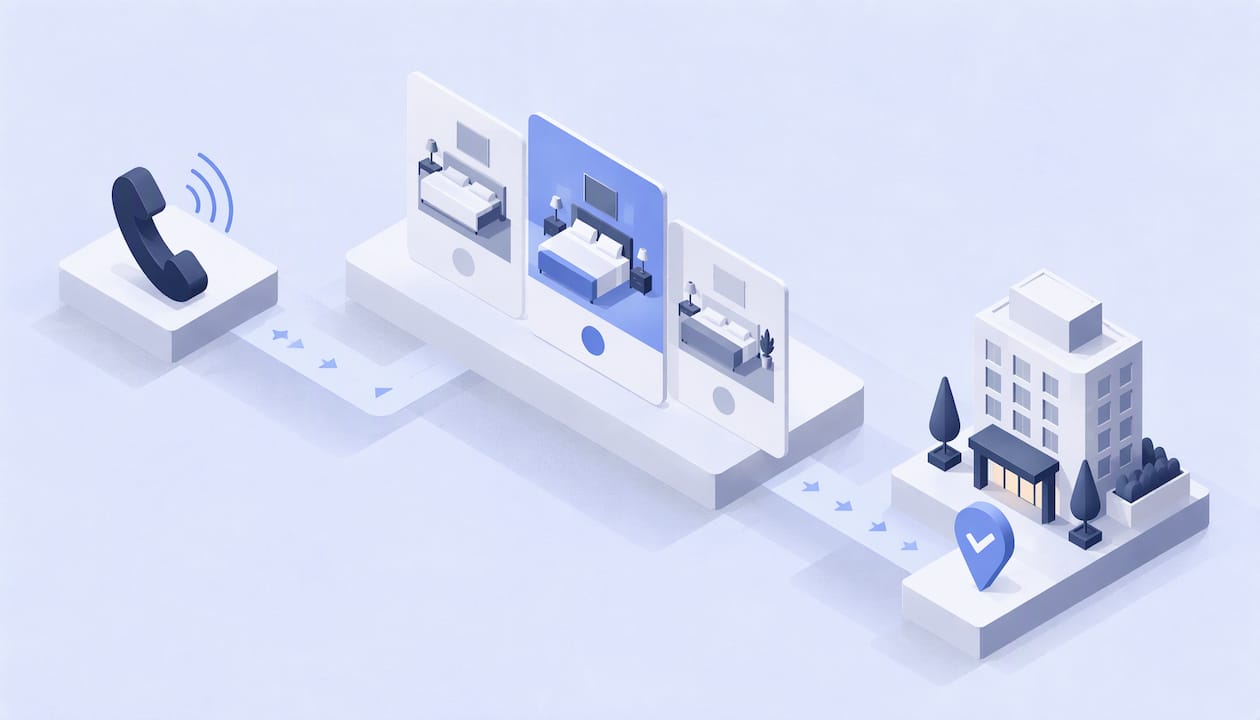
A hotel reservation call center answers calls from guests who want to book, change, or cancel a room. Its main job is to turn each call into a booking made directly with your hotel. That means no OTA fee. You can run one in-house, hand it to an outside team, or mix both. What matters most is that a real person picks up fast and asks for the booking.
This guide is for independent hotel owners and managers. It uses simple words and short steps, so you can use it today.
Free with every demo
Get a website guests and AI both recommend.
- See your new AI-visible website on the call
- Social content made and posted for you
- The website is yours to keep, free
Key Takeaways
- About 18% of hotel reservations come by phone, and about half of inbound reservation calls in North America turn into bookings.
- Speed matters. When hold times pass 2 minutes, hotels lose about 47% of callers before they book.
- A good call has a plan: greet, ask about the trip, suggest a room, answer worries, and ask for the booking.
- Track a few numbers each month: calls answered, wait time, calls that book, and email capture.
- Your website and online profiles should make the phone number easy to find and the call easy to start.
What a hotel reservation call center does
A reservation call center is a team (or a desk) that handles calls about rooms. The agents do a few things:
- Answer questions about rooms, rates, parking, pets, and fees.
- Take new bookings and give a confirmation number.
- Change or cancel stays.
- Offer upgrades, packages, and extras like dining or spa.
- Write down who called and why, so someone can follow up.
Some people think calls are a cost. Many hotels now see the phone as a sales tool. Outrigger Hospitality Group’s contact center leader said that the phone used to be seen as a cost because it takes a lot of labor, but hotels now treat it as a channel that works with the website, not against it.
The same article says calls still bring in five to seven percent of hotel revenue, and sometimes up to 10%.
Why callers call
A guest often finds your hotel online first. They visit the website, read reviews, and compare a few places. Then they call with one last question. It might be about room beds, parking, resort fees, pets, or access needs. That call is often the final step before they book.
If nobody answers, the guest does not wait. They may book on an OTA, pick another hotel, or give up. You pay a fee in the first case and lose the stay in the other two.
Why direct calls pay off
OTAs take a cut. One report says OTA commissions sit between 15% and 30% per booking in 2025. The same report, citing SiteMinder, says direct bookings averaged $519 per reservation in 2024, against $320 through OTAs. A phone booking keeps that fee in your pocket.

What a good booking call looks like
A good call is not a script read in a flat voice. It is a short, friendly chat with a clear order. Many hotels train their staff to follow these steps.
- Answer fast. Pick up within three rings. Say the hotel name, your name, and a warm hello.
- Get the caller’s name. Use it once or twice during the call.
- Ask about the trip. Is it a family visit, a work stay, or a special day? Do this before you talk price.
- Suggest one or two rooms. Pick rooms that fit what the guest told you.
- Say the full price. Give the rate per night, the number of nights, and the total, and say what is in it.
- Ask for the booking. Do not just share facts and wait.
- Confirm everything. Read back the details and give a confirmation number.
This order follows a common phone sales plan: connect, discover, recommend, handle objections, close. We list it as a training idea, and you can adapt it to your own hotel.
What to confirm before the call ends
A phone booking needs a few details. Staff should confirm:
- The guest’s full name and how to spell it
- Phone number and email
- Check-in and check-out dates
- Room type
- How many adults and children, and the children’s ages
- Any special requests
- A card to guarantee the stay
- The cancellation deadline and any fee
- A loyalty number, if the guest has one
Then read it all back. Say if the stay is confirmed, and give the confirmation number from your booking system. Send the email soon after the call, ideally within 30 minutes.
Do not read a list of features
Today’s callers have already done homework. Industry writers note that these guests do not want a scripted list of features. They want help. Listen first, then answer what they asked.
One reservations agent with about fourteen years at Hershey Entertainment and Resorts said agents can paint a picture and explain why a certain room or package fits a visit. A website can’t do that.
Missed calls and after-hours calls
Most hotels lose money here without seeing it. A caller who reaches voicemail often does not call back. Many book with a rival, often on an OTA. One playbook says that missed calls convert at under 10%, and that after-hours callers are often ready to book.
Here is a simple plan:
- Fix your voicemail. Say your staffed hours, promise a callback time, and give a path for emergencies.
- Add a second phone. At busy times, send calls to another staff member when the first line is busy.
- Keep a daily lead log. Write the name, dates, room, and the reason the guest hesitated. Follow up the same day by text or email.
- Use a phone-friendly booking system. Staff should be able to confirm a room without making the caller wait.
Wait time is a big deal. HSMAI reports that when hold times go past 2 minutes, hotels lose about 47% of callers before they book.
Write good notes
Good notes help the next agent. One Hospitality Net writer says that clear notes on contact details, trip dates, tastes, and price range make follow-ups easy. They also give you data for later marketing. Use the same note format for every call.
Teach your team to ask for the booking
Many agents are kind and know the hotel well. Yet they still lose bookings. The reason is often simple: they never ask. They share facts and wait. The caller says thanks and hangs up.
A few habits fix this:
- Ask two or three questions about the trip before you talk price.
- Give a clear answer, not a vague one.
- When a guest worries about price, explain the value before you cut the rate.
- End with a plain question: “Would you like me to book that for you today?”
Practice works better than just reviewing old calls. Role-play with a coworker, get specific feedback, and try again. Do this for 10 minutes each week.
Trained agents can close a lot of calls. One report says properly trained agents close up to 70% of qualified calls. Typical call conversion ranges from 15% to 30%, depending on staffing and training, says HSMAI.
In-house, outsourced, or both?
An independent hotel has three main choices. None is right for every property. Pick the one that fits your size, your hours, and your budget.
| Option | How it works | Good fit when |
|---|---|---|
| In-house | Your front desk or a small reservations team answers | You know your rooms well and have staff free to answer |
| Outsourced | An outside team answers and sells for you | You need more hours covered, or want a dedicated sales voice |
| Hybrid | Your team takes the day, an outside team takes overflow and nights | You want local feel and full coverage |
HSMAI’s research shows how hotel contact centers are set up. 48% are in-house only, 48% are hybrid, and 4% are fully outsourced. Nearly half now use a mix of both. It also says 65% of companies rank revenue as the top goal for their contact centers.
An older industry study found something worth knowing. Third-party contact centers had a net conversion of 45.85%, against 35.75% for self-run centers. Gross conversion was about the same. The data is from 2017, so use it as a guide, not a promise.
Questions to ask before you choose
- Who answers at 9 p.m. on a Saturday?
- Does the team know our rooms, our town, and our rules?
- Do agents ask for the booking, or only take orders?
- Can we see call notes and results each month?
- How long does an agent stay on the team? Turnover hurts quality.
Group bookings are a special case. Sports teams, weddings, and work crews book many rooms at once. They need a sales call, not just an order taker. That is why many hotels add proactive outreach for group business on top of the front desk.
Numbers to track
You cannot fix what you do not measure. Start with a short list.
| Number | What it tells you |
|---|---|
| Calls answered | How many callers reach a person |
| Average wait time | Whether callers give up |
| Call abandonment rate | How many hang up before an answer |
| Calls that book | How well your team sells |
| Email capture rate | How many callers you can follow up with |
| Average revenue per booking | What each call is worth |
Sources like Revinate’s benchmark report give you rough targets. It found that about half of high-intent lead callers book, and that the average email capture rate for non-booked calls is 69.3%. It also found North American hotels get 23 to 30.4 inbound calls per room each month.
To motivate staff, one hotel trade site suggests posting the average revenue per booking by the desk phone. It reminds the team that a single call can be worth a lot, most of all for suites, long stays, and hotels with dining or a spa.
A simple monthly check
- Count calls received and calls answered.
- Count bookings from those calls.
- Divide bookings by calls to get your conversion rate.
- Listen to five calls, two good and three average.
- Pick one skill to practice next month.
Help guests find your number
A call center is no use if guests cannot find the phone number. Put your toll-free and local numbers in the header or footer of every page, and in the contact section. Add click-to-call for phones. A Hospitality Net writer notes that 70% of customers expect this convenience.
Many hotels hide the number in tiny text or behind an extra click. Hotel Online advises posting it in plain view. It also suggests a note that tells guests you have onsite or dedicated reservations staff, which builds trust.
The same goes for your Google Business Profile and OTA listings. Check that the phone number, hours, and photos match everywhere. A wrong number sends a ready buyer to a dead end. Our online presence repair work covers this clean-up.

Guests also ask AI tools where to stay. If your site is clear and easy to read, those tools can better recommend you. Our guide on how AI recommends independent hotels explains how.
Our view: calls are sales, not chores
We work with independent hotels every day. Here is what we believe.
A phone call is a guest raising a hand. They are close to booking. Treat it like sales, and you keep the money an OTA would take.
Most small hotels do not have a big marketing team. They have a busy front desk, a manager who wears five hats, and a phone that rings at the worst time. That is why we built our Direct Booking System around real selling, not just a nicer website.
Our approach joins a few parts. A remote sales team reaches out for group bookings. Social media builds an audience of guests who may book direct. Online presence repair makes sure your Google profile, OTA listings, and reviews send people to you. All of it is meant to cut your OTA dependence and grow bookings with no commission.
We also aim to deploy within 30 days. A hotel should not wait half a year to see a change.
Start with the basics: answer fast, ask about the trip, and ask for the booking. Then add help where your team runs out of hours.
Chirag
Get help with direct bookings
If your phone rings more than your team can handle, or it rings too little, we can help. Our Direct Booking System pairs sales outreach, social media, and online presence repair for independent hotels. You can also see all our hotel marketing services, or contact us to talk about your property. For more ideas, read our direct booking playbook for independent hotels.
FAQ
How do you make a hotel reservation by phone?
Call the hotel’s reservation line and share your dates, room type, and how many guests are coming. The agent will quote the price, ask for your name, contact details, and a card to guarantee the stay. Ask for the cancellation deadline and get a confirmation number before you hang up.
What should a hotel do when no one can answer the phone?
Use a voicemail message that gives your staffed hours and a callback time. Send busy calls to a second person, and follow up the same day by text or email. Most callers who hit voicemail do not call back, so a fast reply keeps the booking.
What is a good conversion rate for hotel booking calls?
HSMAI says typical reservation call conversion is between 15% and 30%, depending on staffing and training. It also reports that about half of inbound calls in North America convert on average. Track your own rate each month and aim to move it up.
Should a small hotel outsource its reservation calls?
It can be a good move when you need more hours covered or stronger sales skills. Many hotels use a hybrid: their own team in the day, and outside help for overflow and nights. Look at your call volume, your hours, and how well your team sells.
How can a hotel get more booking calls?
Show your phone number on every page, with click-to-call for phones. Keep the number the same on your Google profile and OTA listings. Add a short note that real reservations staff are ready to help.
Sources
- HSMAI Americas: The Contact Center’s Role in Commercial Strategy
- HSMAI Americas: Beyond the Call, 5 Ways Contact Centers Shape Commercial Success
- Future of Hospitality: Hotel call center, from cost center to revenue engine
- Hospitality Net: 8 ways to increase hotel phone bookings and grow direct revenue
- Hospitality Net: 12 Easy Ways To Secure More Direct Voice Reservations
- Hotel Online: Pick Up Your Calls to Pick Up More Bookings
- Hotel Business Archive: How Contact Centers Can Drive Market Share
- Revinate: 2024 Hospitality Benchmark Report
- Stayntouch: How to Increase Hotel Phone Bookings
- 1Point1: How Hotel Reservation Outsourcing Services Help Hospitality Brands